St Martin's Day
Historical Context
St Martin's Day falls on 11 November every year. It is not an official public holiday, but a beloved tradition in parts of Flanders and East Belgium where children walk from door to door with lanterns.
St Martin's Day commemorates Martin of Tours, a Roman soldier of the fourth century who, according to legend, cut his cloak in two at the gates of Amiens and gave half to a beggar. His feast day on 11 November was more popular than St Nicholas Day in the Middle Ages and marked the transition from autumn to winter, the slaughter of livestock and the payment of annual rents. In the Denderstreek region, St Martin still largely replaces St Nicholas as gift-bringer. Since 2009, the St Martin and St Nicholas traditions have been recognised as intangible cultural heritage of Flanders.
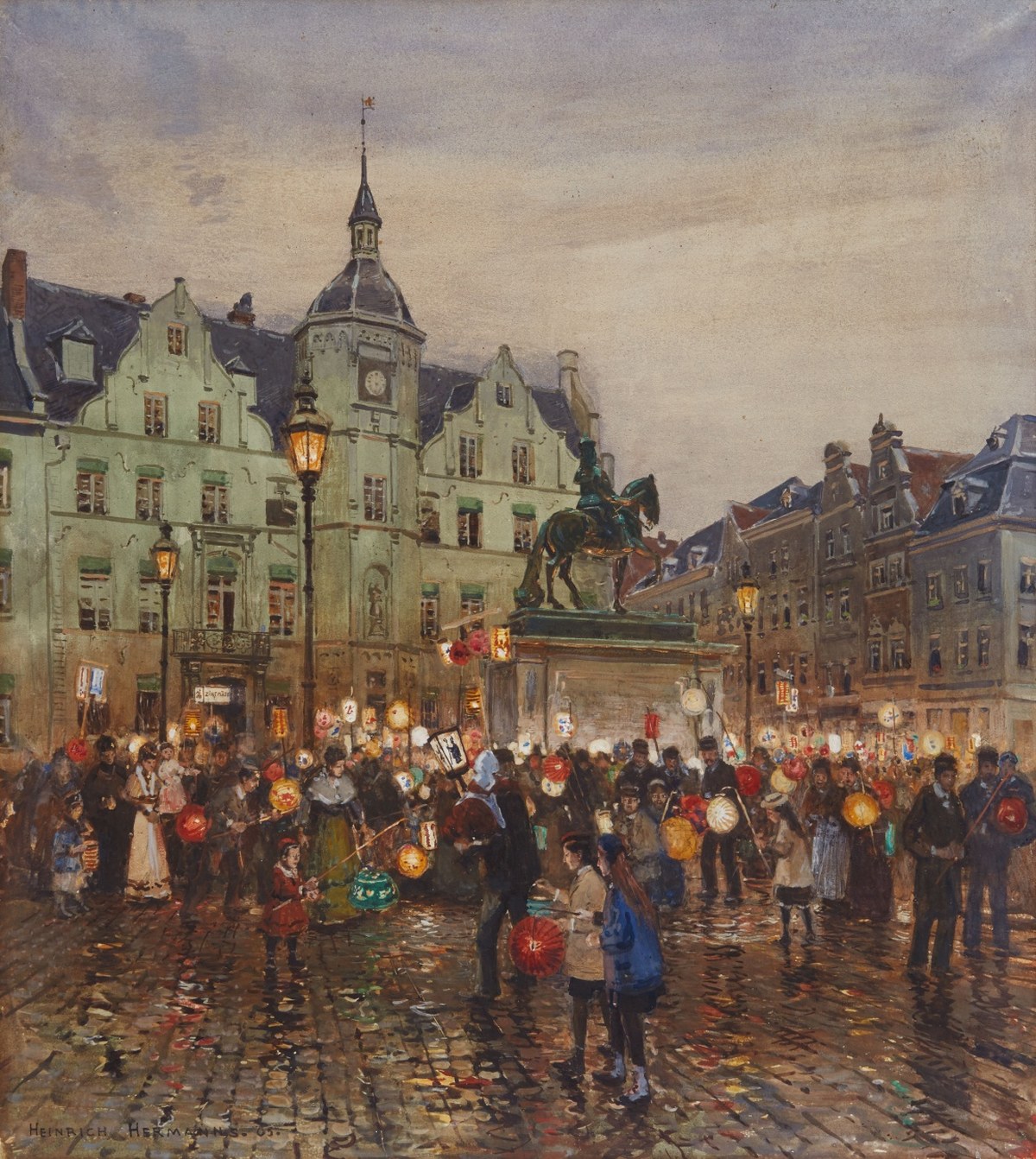
Children make lanterns at school or at home and walk from door to door singing on the evening of 11 November. One of the best-known songs is 'Sint Maarten, Sint Maarten, de koeien hebben staarten,' though dozens of regional variants exist. In return, they receive sweets, fruit or small change. In the Kempen and Limburg regions, St Martin's bonfires are lit. In East Belgium, Martinszüge (St Martin's processions) pass through towns such as Eupen, Büllingen and Sankt Vith.
Regional Traditions
Aalst
St Martin arrives by boat on the Saturday before 11 November and rides in a carriage to the Grote Markt. The evening light procession and the light walk (1.7 km) with light and art installations attract thousands of visitors. In the Denderstreek, St Martin largely replaces St Nicholas as gift-bringer.
Ypres
St Martin arrives by boat. Children parade in the evening with lanterns carved from vegetables through the city. The tradition is strong throughout the Westhoek region.
Mechelen
Here the tradition is called 'Sinte-Mette' and features its own dialect songs, such as 'Sinte-Mette van de ruggenuchte.' Both St Martin and St Nicholas are celebrated in Mechelen, unlike in Aalst where only St Martin comes.
Eupen
The largest Martinszug in East Belgium, held annually since 1963 (first documented celebration from 1779). The procession departs at 6 PM from St Joseph's Church with some 40 soldiers, Roman supply wagons and three marching bands. On the Werthplatz, the cloak-sharing scene is re-enacted at the Martinsfeuer.
Malmedy
On 10 November, three neighbourhoods (banes) compete to build the largest St Martin's bonfire. The pyre can reach up to ten metres, crowned with an effigy. Children with lanterns and musicians form a 'cortège lumineux.' Everyone sings 'L'eveuye du Sint-Martin' and dances the farandole.